Petri Lankoski
Södertörn University
Definitive version: https://doi.org/10.26503/dl.v2026i3.2804
In DiGRA 2026 Conference Proceedings
ABSTRACT
This paper explores how indie pornographic videogames represent and sexualise monstrosity. Twenty-five games were analysed using qualitative content analysis to examine how design, narrative, and visual elements articulate the relationship between sexuality, fear, and taboo. Three recurring themes emerged: Sexy, Not Human, and Horny; Monstrous Seduction and the Erosion of Will; and Dominance, Violence, and Sexual Control. These themes reveal how pornographic horror games mobilise the monstrous body as a site where desire, disgust, and transgression intersect. These games employ mechanics and aesthetics that invite players to engage with fantasies of danger, submission, and control. The fusion of attraction and repulsion becomes a core ludic and affective dynamic, shaping how players experience the interplay of pleasure and horror. The analysis argues that such games reconfigure cultural narratives of gender and sexuality through interactive design, positioning the monstrous body as both object of desire and vehicle for exploring the limits of acceptable pleasure.
Keywords
monster, pornography, single-player videogames, desire
INTRODUCTION
The representation of monsters in adult games goes beyond the traditional role of these creatures as mere threats or adversaries. Instead, these games often present monsters as objects of desire, blurring the line between fear and attraction. This phenomenon is not new, as it can be traced back to various forms of media that mix horror and sex; for example, the eroticization of monsters stretches back to antiquity. In Greek mythology, for instance, satyrs (half-human, half-goat beings) were notorious seducers, embodying unrestrained lust and excess. Later, in Malleus Maleficarum, Kraemer (1928) in 1508 warned that succubi and incubi could corrupt both body and soul through bodily contact, casting sexualized monsters as demonic threats. Centuries later, Gothic and horror traditions transformed this fear into allure: films like The Vampire Lovers (1970) popularised the image of the seductive vampire, while horror literature, such as Poppy Z. Brite’s Love in Vein, introduced overtly pornographic encounters with the undead. In the late 20th century, horror porn parodies like Evil Head reimagined earlier scenes of monstrous assault (see also Williams 1989, 198), while Japanese animation developed its own aesthetics of fusing monstrosity with sexuality. In the 21st century, the trend has extended into digital publishing, where “monster porn” has emerged as a subgenre of self-published ebooks sold on platforms like Amazon (Spitznagel 2013; McGreal 2014). The sexy monsters are not merely a phenomenon within adult entertainment but also within Mattel’s Monster High dolls and television series (cf. Baker 2019). As monster porn has been discussed elsewhere (Paasonen 2018; Saunders 2023; Stang 2025), I focus instead on monster pornography in adult videogames.
Given this context, it is unsurprising that monster porn has found a significant place in the realm of adult games. For example, Steam and Itch.io sell such adult games, utilising cartoon/anime-style hand-drawn or 3D-rendered graphics that depict monsters not merely as entities to be feared but also as objects of desire. Some of the pornographic games with monsters follow the logic Saunders describes
Monster porn markets itself as a thrillingly disturbing outlier of pornographic film media. Its grotesque antagonists ooze pus and ejaculate as they drag their distended genitalia through endless rape scenes and melancholy, apocalyptic landscapes. (Saunders 2023)
While non-consensual sex is reported to be somewhat familiar in pornographic videogames (Lankoski et al. 2023) and sexual violence and monsters are combined in videogames, some games focus on the hypersexual monsters without delving into sexual violence in this way. I return to this below.
What a monster requires clarification before moving forward. Carroll (1990) defines a monster as an impossible being that evokes disgust and fear, typically by violating expectations and combining human and nonhuman elements. For example, a zombie is both dead and alive at the same time, while Medusa is human-like but has snakes growing from her head instead of hair. Cohen’s description of the monster follows a similar logic, but he develops a series of theses that expand this idea. According to Cohen (1996):
- The monster always survives.
- The monster defies categorisation and resists traditional classification.
- The monster embodies cultural difference, which justifies its expulsion.
- The monster polices the borders of the possible, for example, by punishing curiosity.
- The fear of the monster is connected to desire—the monster’s body allows the safe expression of fantasies of aggression.
- The monster invites us to re-evaluate our assumptions about culture, gender, sex, race, and tolerance.
When applied to sexualized monsters in games, the definition of monster extends beyond fear and disgust to include desire. These creatures often merge non-human traits with exaggerated sexual features, producing figures that are simultaneously alluring and unsettling. In this way, their monstrosity is not only a violation of natural categories but also of sexual norms, inviting players to confront taboos around desire, power, and the eroticization of the Other. Cohen’s (1996) assertion that “fear of the monsters is really kind of desire” works as a starting point for the exploration of the pornographic monsters. In the adult games, this desire is taken further, where the desire directed at the monster overshadows the fear. For example, The Monster College is a pornographic twist on teen college dramas, where monsters become the focus of lust rather than terror. Similarly, games like Ravager allow players to inhabit the role of a powerful dragon, indulging in various sexual encounters with humans—both consensual and non-consensual—thereby enabling and justifying power fantasies, including those involving rape. The ethics of such narrative content is outside the scope of this paper, as it is a complex topic in its own right (see, e.g., Mikkola 2019, 22–50, 160–69).
Both horror and porn are body genres, characterised by bodily expressions of sensations or emotions. Porn focuses on sexual pleasure and orgasm, while horror centres on fear and disgust evoked by the monster (Williams 1991; Carroll 1990). Lankoski (2012) has argued that players react emotionally to games:
- Through empathic responses to characters’ emotional expressions.
- Through goal-driven engagement—for example, experiencing pleasure when achieving a goal, fear when the character they control is in danger, or disgust when they must interact with or overcome something perceived as contaminating or spoiled.
- With pleasure in perceived beauty.
Notably, empathic responses to bodily expressed sensations of sexual pleasure, according to this framework, guide the player’s emotional experience. When a protective frame or safety net is present—such as when frightening events occur within the game but cannot truly harm the player—negative emotions, such as fear or disgust, can be transformed into positive, pleasurable experiences (Apter 2007).
The study of pornographic representations of monsters offers valuable insight into the cultural construction of sexuality, desire, and power. These figures (vampires, demons, succubi, and other hybrid beings) extend a long tradition in which the monstrous body functions as a site for negotiating transgression and the boundaries of the acceptable. Pornographic depictions amplify dynamics of seduction, coercion, and submission, making them particularly revealing of how gendered and sexual ideologies operate through fantasy. Examining these representations also connects pornography to broader media contexts: the same eroticised monstrosity found in porn games echoes through mainstream works such as True Blood, Buffy the Vampire Slayer, or Monster High, suggesting a continuum rather than a separation between adult and popular culture. Studying porn monsters thus illuminates how erotic horror tropes circulate across genres and media, shaping cultural discourses around consent, desire, and agency. Moreover, such analysis contributes to game and media studies by addressing a domain where game structure and affect intersect with moral and emotional complexity. In this sense, porn monsters provide a critical lens for understanding how contemporary media use the monstrous to stage and problematize the relations between pleasure, danger, and power.
I do not address the ethical or societal issues surrounding monster porn or pornography in this study. A meaningful exploration of such questions would require a separate, dedicated analysis. These topics, although less frequently in relation to game pornography, have been discussed elsewhere (e.g., Mikkola 2019; Galbraith 2021; 2017; Coleman and Held 2014).
This paper explores the monsters in pornographic videogames to understand the desire that games afford while playing monsters or having sexual encounters with them. Porn games in general have been (e.g., Passmore et al. 2020; Lankoski and Välisalo 2023; Lankoski et al. 2023; Brown 2008; Brathwaite 2007), and monsters in regular games (e.g., Perron 2009; 2011; Švelch 2023) have been discussed elsewhere.
METHOD
The games analysed were acquired through Steam and itch.io. The selection process began by searching for “Sexual content” on Steam and “Adult” on itch.io. From these results, games that explicitly mentioned monsters were chosen for further analysis. After selecting the initial set, the games were analysed in detail, and additional titles were identified through follow-up searches and Steam’s “recommended based on what you play” and itch.io’s “related games” features. 25 games were analysed. The complete list of analysed games is presented in the Appendix.
The games were played and, where possible, supplemented with walkthrough videos, game data files, and scripts to gain an understanding of player choices and their consequences. The analysis employed thematic analysis, with themes developed from the data. In the final stage, theoretical concepts were incorporated into the theme labels when clear connections to existing theory became apparent. The games are examined through the lens of Cohen’s (1996) monster theory and Lankoski’s (2012; 2011) engagement approach. The study examines the types of engagement with the monsters, with an emphasis on game structures and representations.
RESULTS
Although the selection of games was not based on random sampling, the titles were deliberately chosen for their inclusion of monstrous figures. A brief overview of the sample composition is warranted. In 32% of games, the player character (PC) is depicted as a monster, whereas in one title, the PC can be customised to include non-human anatomical features (e.g., a non-human penis). The majority of games (65%) feature a male PC, while 7% feature a female PC. One game includes a non-binary PC, and in two cases, players can select the PC’s gender (between male and female in one instance, and among male, female, and non-binary options in the other). In one game, the PC is a man who is transformed into a woman, with gender alternating between male and female at different points in the narrative. Across the sample, the games depict a range of sexual interactions, most of which are either heterosexual or heterosexualized portrayals of same-sex encounters. The games include both consensual and non-consensual sex.
Taken together, these games construct a diverse yet patterned landscape of sexualized monstrosity. The player’s position (whether human or non-human, dominant or submissive) shapes how sex, power, and fear are negotiated within the game’s mechanics and narratives. From this material, three interrelated themes emerged: Sexy, not human, and horny; Monstrous seduction and the erosion of will; and Dominance, violence, and sexual control. These themes illuminate how the games mobilise the aesthetics of monstrosity to intertwine desire and danger, and how design elements encourage players to engage emotionally and ethically with transgressive sexual dynamics. Next, we look at the themes in more detail,
Sexy, Not a Human and Horny
The aesthetic of the monster often merges beauty with varying degrees of non-human features and grotesqueness, and exaggerates physical traits. Male monsters are frequently portrayed with muscular bodies and oversized genitalia, while female monsters are commonly depicted with exaggerated hourglass figures or a combination of male and female characteristics. Figure 1 shows a set of monsters from various games.
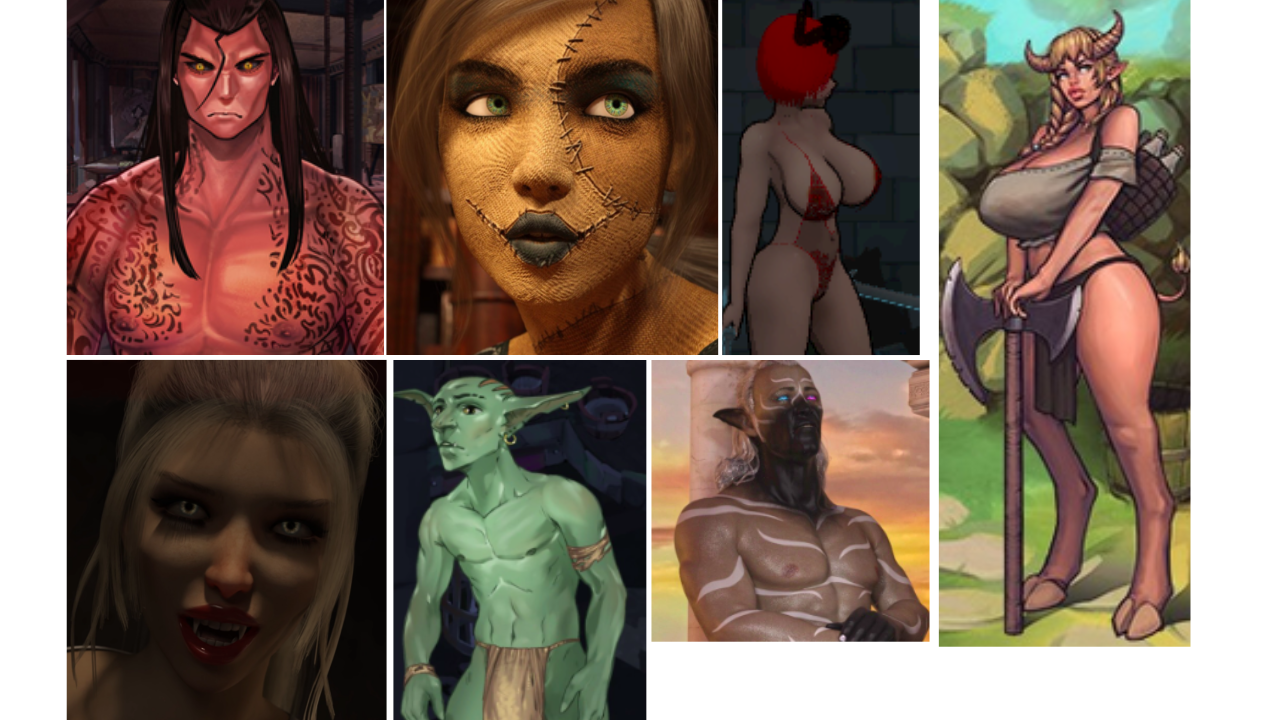
Figure 1. Monsters from left to right, top first: Seeds of Chaos, Monster College, Succubus The Lustborn Curse, Warlock and Boobs, The Bite: Reverant, and Lord Goblin.
In Monster College, for example, the player character (PC) is a werewolf who can take three forms: human, werewolf, and hybrid. All forms share the feature of an oversized penis but differ in how many human characteristics are retained. The werewolf form is notably not a full wolf, maintaining a hybrid appeal. While most sex scenes take place in human form, some allow the player to choose which form the PC inhabits, giving players control over the degree of monstrosity.
Seeds of Chaos, a dark fantasy game, features a variety of monsters. Unlike Monster College, it includes homosexual and non-binary sex options, as well as encounters with other male characters. Female orcs combine non-human traits (green skin, tusks, fangs) with curvaceous figures, while a minotaur is depicted with a muscular human body, an ox head, and an oversized, partly non-human penis. A succubus is presented as a hermaphrodite: feminine in appearance but with both male and female sexual organs. The male demon has a muscular build, red tattooed skin, and large genitalia, whereas the female demon is curvaceous with blue skin and small horns. The gendered differences extend to behaviour: male demons favour direct, combative approaches, while female demons rely on cunning, stealth, or manipulation.
These designs combine hypersexual features often considered attractive in pornography by men: large breasts, oversized penises, wide hips, and rounded buttocks (Ogas and Gaddam 2011, 23–61) with added monstrous features. Part of their sexual appeal can be linked to teratophilia, a paraphilia describing sexual attraction to monsters or monstrous-looking individuals (Kinkly 2025). Across these games, monsters are consistently depicted as hypersexual and always ready for sex. This, however, does not differ markedly from the portrayal of human PCs, who are also frequently available. One notable exception appears in Warlock and Boobs, where the human PC has a “horniness” stat that affects when sex can be initiated: if the stat is too low, the option is unavailable. However, when monsters initiate sex after a lost fight, the PC is always depicted as willing.
Being sexy and always ready (and able) for sex can be seen as traits that strengthen the player’s sympathy for the PC, fostering identification and emotional investment (cf. Lankoski 2011). This allegiance is reinforced by the combination of familiar sexual cues and monstrous features, which create an affective tension reminiscent of taboo. As Williams (2004) argues in the context of intercaral pornography, pornography’s appeal often stems from the interplay between prohibition and desire—the very taboos that restrict pleasure also heighten it, producing excitement through the fusion of fear and attraction. Similarly, in these games, the monstrous body, both desirable and repulsive, intensifies arousal by evoking fear and disgust, emotions that paradoxically deepen the player’s engagement and attachment to the PC.
Dominance, Violence, and Sexual Control
Monsters and non-voluntary sex often go hand in hand in these games, echoing tropes such as involuntary erotic transformation in vampire fiction (see Waddell 2017). Scenarios where manipulation through violence, blackmail, or other forms of coercion leads to sex are common examples. Both forms are tied to power fantasies of dominance and submission (cf. Zurbriggen and Yost 2004). These narratives allow players to engage with power fantasies without the ethical concerns associated with pornography involving real people (cf. Paasonen 2011).
In Seeds of Chaos, the PC is blackmailed by two demons into assisting them. Early in the narrative, the demons test the PC’s submission by demanding that he sexually please either the female or the male demon. Later in the game, the PC can command an incubus to seduce a nun and then watch as the sexual encounter unfolds. These mechanics position the player within a dynamic of power and consent: the PC’s choices are framed by coercion, where consent is undermined by blackmail and manipulation. At the same time, the game offers a corruption pathway, in which the player can either resist and remain a victim of the demons’ control or embrace their influence and become a human monster—someone who dominates and exploits others while remaining subject to demonic power. In this way, the game intertwines consent, domination, and corruption into its progression structure, foregrounding the blurred lines between agency and coercion in erotic play. Moreover, the choices offered allow players to engage in sexual fetishes they feel excited or comfortable with and avoid those that they are not comfortable with.
Ravager, a dark fantasy game where the PC is a dragon, is a power fantasy. While the game allows the dragon to be merciful or cruel, the game’s structure emphasises power dynamics: the dragon is a large, frightening figure that can compel others to obey or die. The game can be played in power-fantasy and dark-fantasy modes. In the dark fantasy mode, there are challenges where one can fail to reach the goal, or the dragon can be killed. The power fantasy mode removes the challenges. The game revolves around the dragon building its power and collecting a harem of women. While the game allows the PC to be kind, build respect and seduce women to join his harem and build his empire, it also allows the use of violence and coercion to build one’s empire and harem. The structure of choices and available actions indicates that the PC, because of the power of the dragon, is in control and can do what he chooses to do.
On the other hand, in the modern horror game Anthophobia and the fantasy game DancingReaper, the monsters function more like traditional horror antagonists. The player character must fight against them, and the only sexual content appears when the PC dies, at which point the killer has sex with the dead or dying body in a cutscene. This kind of structure and representation plays around with the death-related sexual fantasies, somnophilic and necrophilic fantasies (see Knafo 2015). These fantasies are interconnected, as both involve feigned passivity or feigned death. However, the games’ differing presentations and structures provide distinct ways of exploring and framing these fantasies, allowing delving into rather extreme submissive fantasies, assuming that the player aligns themselves with the PC.
Monstrous Seduction and the Erosion of Will
In Mythic Manor, a modern fantasy game where one of the characters is a ram demon, which is similar to a succubus, that can make people bend to her will, which she uses several times in her quest line to a woman, breast to the PC, or to masturbate on her and the PC’s presence. In some games, the goal is to corrupt someone innocent to be a sexually deviant or obedient sex slave using mind control and manipulation, as in Dreams of Desire. While the PC is not a monster per se, he acquires magical powers from monsters and needs to use the powers to dominate others and make them have sex with him without consent. In The Bite – Revenant and Mythic Manor, the vampires and the ram demon can control humans through mental domination. These monsters draw on the tradition of erotic horror and vampire fiction, where seduction, compulsion, and the blurring of consent are central themes. Such motifs can be traced to succubus and satyrs in stories discussed above and films like The Vampire Lovers (1970), Lust for a Vampire (1971), and Vampyros Lesbos (1971), which fuse horror and eroticism by portraying vampires as irresistibly seductive figures who subdue their victims through supernatural allure rather than physical force (see Heller-Nicholas 2017; Waddell 2017). However, while the vampires in these films are sexualized, their acts of bloodsucking symbolically replace sex; in contrast, pornographic games literalize this eroticism, depicting vampires who engage in explicit sexual acts.
In Genesis Order, the PC encounters a group of female demons, and they desire new flesh. The PC is reluctant: ‘I have to go… I should not be here’, but he cannot resist the lure of demons. This leads to a sex scene with the demons.
In The Sword of Succubus, the PC is a female succubus who, in addition to engaging in regular combat, can seduce certain opponents, have sex with them, and produce milk for various purposes—pacifying her opponents, at least temporarily. Similarly, in Succubus: The Lustborn Curse, the succubus PC can seduce enemies in battle; following the sexual encounter, she recovers a portion of her health, and the monster dies.
Consent and desire, therefore, operate in an ambiguous space where seduction, manipulation, and supernatural power complicate notions of free will. This ambiguity is mirrored in games that incorporate erotic horror elements, raising questions about how these themes shape player perceptions of desire, dominance, and the ethics of sexual agency within fictional worlds. Similarly, the first season of the Jessica Jones (USA, 2015) television series centres its main plot on consent and on how a character with supernatural powers compels others to do his bidding (see Green 2019).
These games connect to the idea of seductive monsters and the tales of succubi and incubi—demons who engage in sexual acts with humans, often bypassing explicit consent through enchantment or dreamlike states—originate in European and Middle Eastern folklore. These myths frame sexuality through supernatural coercion, where the boundaries between desire, submission, and predation blur. This context reveals how vampire fiction, and games inspired by it, often problematize the notion of consent, intertwining pleasure and danger in ways that challenge conventional ideas of agency and autonomy. The Lilith myth and succubi seducing men further foreground female hypersexuality. (cf. Santos 2017, 63).
The female monsters discussed above exemplify “a literary Gothic trope in which female demons, spirits, and ghosts participate in a transgressive hauntology that reframes notions of consent and heteronormative sexual violence” (Chow 2022). Through their supernatural agency and sexual assertiveness, these figures destabilise traditional binaries of victim and aggressor, simultaneously embodying desire and danger. They complicate consent by merging seduction with compulsion, suggesting that power and vulnerability can coexist within the same figure.
In contrast, male monsters tend to reproduce more conventional gendered power structures typical of pornography, where the male assumes the role of the dominant sexual agent and the female is positioned as the passive or submissive counterpart (see Klaassen and Peter 2015).
DISCUSSION AND CONCLUSIONS
Monsters in these games are impure in Carroll’s (1990) sense, combining human and non-human features. The games also follow conventions of monster toon pornography (see Paasonen 2018) with exaggerated penises, muscles, and breasts, often combined in rape and other domination/submission acts. The games partially offer the “I” experience (cf. Lankoski 2011) by giving (some) control over how the game progresses while offering settings with monsters that combine non-human features with sexually desirable features and power fantasies. Monsters and corrupt virtuous characters tend to be open to all kinds of sexual exploitations. The story and game mechanics create a context of sex scenes, and the concept of the monster justifies all sorts of transgressive power fantasies (and in some cases at least partly) perverse allegiances and abnormalities. Perverse allegiances, according to Smith (1999), refer to sympathy for a (film) character because of the character’s depraved or repulsive (or despite) features. However, he maintains that the desirable features are drivers of sympathy. Lankoski (2011) extends this argument by claiming that players form allegiance not because the character is morally good, but because the game’s structure (through alignment with their perspective, goals, and affective cues) encourages empathy or sympathy despite ethical discomfort. This is common in erotic horror and pornographic games, where the player may assume the role of a seductive monster or morally dubious protagonist. The mechanics of play and narrative framing can sustain engagement even as the character enacts coercion, violence, or taboo acts, creating a space where empathy and revulsion coexist. In this sense, games not only invite but also operationalise perverse allegiance through interactivity.
The ideal of male monsters in many cases seems to inherit the machismo man ideology described by Mosher and Tomkins (1988), where masculinity is defined through dominance, virility, and physical strength. In this framework, the real man is exalted for his ability to control others and demonstrate sexual prowess. While the assertion of dominance can sometimes be negotiated or contested within the narratives and gameplay of the analysed games, the qualities of virility, physicality, and overall capability are presented as inherent and non-negotiable. These traits are often portrayed as naturalised, unavoidable aspects of masculinity, reinforcing the idea that male power is both biologically grounded and socially legitimised. In pornographic games, this framing positions the male monster not only as a figure of sexual threat but also as an exaggerated embodiment of patriarchal ideals, amplifying gendered myths about men as innately dominant and sexually aggressive.
By contrast, female monsters are often framed through seduction rather than physical dominance. Their threat lies in irresistibility, magical allure, or transformative sexuality, echoing cultural stereotypes of women as dangerous temptresses or femme fatales (Santos 2017). Unlike male monsters, whose power is depicted as rooted in physicality and inevitability, female monsters’ power is tied to erotic, intelligence or overwhelming desire. This contrast highlights a clear gendered divide, as evidenced by the differences between the male and female demons in Seeds of Chaos. Male monstrosity often affirms patriarchal ideals of strength and virility, while female monstrosity reinforces cultural myths of femininity as duplicitous, manipulative, and dangerously erotic. However, as Cohen (1996) argues, monsters are never static symbols—they are cultural bodies that both embody and challenge the norms that produce them. From this perspective, female monsters not only reproduce familiar fears about unruly female sexuality (Cohen 1996, Thesis I: The Monster’s Body Is a Cultural Body) but also reveal the instability of gendered binaries (Cohen 1996, Thesis VI: Fear of the Monster Is Really a Kind of Desire). For instance, female orcs deviate from conventional patterns by merging physical strength and violent aggression (traits culturally coded as masculine) with the seductive, dangerous eroticism more commonly associated with demonic femininity. This hybridisation unsettles established categories of gender and sexuality, demonstrating how monstrosity can simultaneously reinforce and subvert patriarchal ideologies (Cohen 1996, Thesis V: The Monster Polices the Borders of the Possible). In this sense, monstrous femininity in games becomes a site where cultural anxieties about power, desire, and gender difference are both performed and contested (cf. Germaine Buckley 2020).
The hybrid representation of female monsters can be understood through Creed’s (2024) notion of the monstrous-feminine, which highlights how female monstrosity is often defined in relation to male fears and desires, frequently positioning women as threatening because of their sexuality (cf. Santos 2017, 131–32). Pornographic games partially contest this by foregrounding the monster’s sexuality instead of its threatening qualities. In Seeds of Chaos, the female demon exemplifies the gendered division of monsters, embodying the fear of seduction and manipulation. In contrast, the female orcs complicate this division by merging traits of physical dominance more commonly associated with male figures. This blending of violent physicality and erotic threat suggests that pornographic games not only reproduce but also reconfigure cultural myths about gender, sexuality, and monstrosity. Linking back to Cohen’s (1996) idea that the monster is a cultural body that both embodies and challenges the fears and desires of the society that produces it. The erotic monster is at once a reflection of heteronormative fantasies of domination and submission and a challenge to sexual and moral boundaries (Cohen 1996, Thesis II: The Monster Always Escapes and Thesis III: The Monster Is the Harbinger of Category Crisis). The monstrous erotic body challenges the binaries of pleasure and fear, male and female, human and inhuman, making visible the instability of cultural definitions of gender and sexuality. In this sense, pornographic games operate as contemporary iterations of horror and pornography, where desire and prohibition intertwine. They not only stage the familiar myth of the dangerous, sexually charged monster but also invite players to inhabit and act through it, thereby transforming the monster into a site of agency and sympathy.
The pleasures of playing as a monster in pornographic games are multifaceted. They often involve the fantasy of being powerful, charismatic, and irresistibly seductive (a figure to whom women willingly or unwillingly surrender). Such play allows players to inhabit a role where acts such as rape, cheating, or maintaining multiple simultaneous relationships can be enacted within the game’s fiction without real-world consequences. Notably, this power is present not only in the game’s story layer but also in gameplay: in the choices and actions the player can perform and in how the game presents them. As seen above, in Raveger, the dragon’s power lies in what it can do and in how its actions are presented, as Lankoski describes, for example, how playing Hulk makes it feel powerful (cf. Lankoski 2010).
On the other hand, these fantasies of non-monogamous sex and power play have real-world counterparts in swinger lifestyles and BDSM practices. However, the non-monogamous fantasies depicted in games tend to align more closely with male fantasies of unrestricted sexual access to women, rather than the reciprocal dynamics found in actual swinging communities, where men typically experience more rejection than women (cf. Ley 2011, 65–66). Porn game fantasies do not have similar risks because of the game’s progression structure or the save system (and with tutorials if needed/wanted), it is possible to succeed and even avoid failures.
Monsters in pornographic and erotic games are often designed to be both sexy and not human, embodying exaggerated sexual traits that make them irresistibly horny while simultaneously marking them as other (cf theme Sexy, not a human and horny). Their non-human nature—vampiric, demonic, or beastlike—creates a safe distance that allows the exploration of fantasies otherwise deemed unacceptable. As Cohen (1996) notes, monsters frequently operate as figures of desire disguised as fear and disgust, and this duality is central to their appeal (cf. Williams 2004). Their exaggerated anatomy, supernatural power, and predatory energy amplify erotic tension while freeing both designers and players from real-world moral constraints. Through such figures, the games invite players to engage fantasies of submission and loss of control within a contained, fictional space.
Closely linked to this is the theme of Monstrous seduction and the erosion of will. In many games, the monster’s power manifests through hypnosis, magic, or irresistible charm that overwhelms a victim’s agency. These dynamics dramatise fantasies of surrender and complicity: the player may simultaneously resist and desire the loss of control that the game, both narratively and mechanically, enables. As Gloyn (2019, 11) observes, these portrayals of seductive monsters evoke cultural anxieties around non-normative sexualities, including sadomasochistic or queer desires, by externalising them into monstrous bodies.
Finally, the recurring motif of Dominance, violence, and sexual control connects eroticism with power. The line between coercion and desire becomes deliberately blurred, with sexual encounters framed as both violent and alluring. Such transgressive content—ranging from supernatural compulsion to bestiality or other taboo acts—intensifies arousal through the thrill of crossing moral boundaries. Here, the player is rarely a detached observer; game mechanics often demand active participation in the acts of domination or surrender. As Paasonen (2011) argues, desire and disgust are not opposites but mutually reinforcing affects that heighten erotic charge. Within the protective frame of gameplay, these emotions merge to transform fear, shame, and repulsion into pleasure.
In this way, pornographic horror videogames use the monstrous body as a conduit for exploring the interplay between fear, disgust, desire, and taboo. The combination of sexual attraction and repulsion—of being Sexy, not human, and horny; of seducing and overpowering; of dominance and submission—reveals how game design mobilises the aesthetics of monstrosity to engage players’ emotions. These games turn the forbidden into a source of fascination, allowing players to safely navigate fantasies of danger, control, and surrender through play.
REFERENCES
Apter, Michael. 2007. Danger: Our Quest for Excitement. Onworld Publications.
Baker, Lucy. 2019. “Monster High’s Draculaura: Dealing with Daddies and Fuckboys.” Continuum 33 (2): 258–69. https://doi.org/10.1080/10304312.2019.1569405.
Brathwaite, Brenda. 2007. Sex in Video Games. Charles River Media.
Brown, Damon. 2008. Porn & Pong: How Grand Theft Auto, Tomb Raider and Other Sexy Games Changed Our Culture. Feral House. http://site.ebrary.com/id/10335157.
Carroll, N. 1990. The Philosophy of Horror: Or, Paradoxes of the Heart. Taylor & Francis.
Chow, Jeremy. 2022. “Succubus Matters.” ABO: Interactive Journal for Women in the Arts, 1640-1830 12 (1). https://doi.org/10.5038/2157-7129.12.1.1273.
Cohen, Jeffrey Jerome. 1996. “Monster Culture (Seven Theses).” In Monster Theory: Reading Culture, edited by Jeffrey Jerome Cohen. University of Minnesota Press.
Coleman, Lindsay, and Jacob M. Held, eds. 2014. The Philosophy of Pornography: Contemporary Perspectives. Rowman and Littlefield. https://doi.org/10.5040/9798881818661.
Creed, Barbara. 2024. The Monstrous-Feminine: Film, Feminism, Psychoanalysis. Second edition. Routledge.
Galbraith, Patrick W. 2017. “Adult Computer Games and the Ethics of Imaginary Violence: Responding to Gamergate from Japan.” U.S.-Japan Women’s Journal 52 (1): 67–88. https://doi.org/10.1353/jwj.2017.0012.
Galbraith, Patrick W. 2021. The Ethics of Affect: Lines and Life in a Tokyo Neighbourhood. Stockholm University Press. https://doi.org/10.16993/bbn.
Germaine Buckley, Chloé. 2020. “A Tale of Two Women: The Female Grotesque in Showtime’s Penny Dreadful.” Feminist Media Studies 20 (3): 361–80. https://doi.org/10.1080/14680777.2019.1583263.
Gloyn, Liz. 2019. Tracking Classical Monsters in Popular Culture. Bloomsbury Academic.
Green, Stephanie. 2019. “Fantasy, Gender and Power in Jessica Jones.” Continuum 33 (2): 173–84. https://doi.org/10.1080/10304312.2019.1569383.
Heller-Nicholas, Alexandra. 2017. “Seductive Kindness: Power, Space and ‘Lesbian’ Vampires.” In Hospitality, Rape and Consent in Vampire Popular Culture, edited by David Baker, Stephanie Green, and Agnieszka Stasiewicz-Bieńkowska. Palgrave Gothic. Springer International Publishing. https://doi.org/10.1007/978-3-319-62782-3_12.
Kinkly. 2025. “Teratophilia.” Kinkly – Straight up Sex Talk With a Twist. https://blog.kinkly.com/definition/teratophilia/.
Klaassen, Marleen J. E., and Jochen Peter. 2015. “Gender (In)Equality in Internet Pornography: A Content Analysis of Popular Pornographic Internet Videos.” The Journal of Sex Research 52 (7): 721–35. https://doi.org/10.1080/00224499.2014.976781.
Knafo, Danielle. 2015. “For the Love of Death: Somnophilic and Necrophilic Acts and Fantasies.” Journal of the American Psychoanalytic Association 63 (5): 857–86. https://doi.org/10.1177/0003065115606132.
Kraemer, Heinrich. 1928. Malleus Maleficarum. With Wellcome Library. [London] : J. Rodker. http://archive.org/details/b3136245x.
Lankoski, Petri. 2010. Character-Driven Game Design: A Design Approach and Its Foundations in Character Engagement. School of Art and Design Publication Series A 101. TAIK Books.
Lankoski, Petri. 2011. “Player Character Engagement in Computer Games.” Games and Culture 6 (4): 291–311. https://doi.org/10.1177/1555412010391088.
Lankoski, Petri. 2012. “Computer Games and Emotions.” In The Philosophy of Computer Games, edited by John Richard Sageng, Hallvard Fossheim, and Tarjei Mandt Larsen. Springer Netherlands. http://www.springerlink.com/content/q568k3q6l7304202/abstract/.
Lankoski, Petri, Thomas Apperley, and J. Tuomas Harviainen. 2023. “Platform-Produced Heteronormativity: A Content Analysis of Adult Videogames on Patreon.” Games and Culture 18 (1): 102–23. https://doi.org/10.1177/15554120221084453.
Lankoski, Petri, and Tanja Välisalo. 2023. “Pornographic Games on Steam: Genres, Modes, and Milieus.” Proceedings of DiGRA 2023.
Ley, David J. 2011. Insatiable Wives: Women Who Stray and the Men Who Love Them. 1st pbk. ed. Rowman & Littlefield.
McGreal, Scott. 2014. “Monster Porn and the Science of Sexuality | Psychology Today.” https://www.psychologytoday.com/us/blog/unique-everybody-else/201403/monster-porn-and-the-science-sexuality.
Mikkola, Mari. 2019. Pornography: A Philosophical Introduction. Oxford University Press.
Mosher, Donald L., and Silvan S. Tomkins. 1988. “Scripting the Macho Man: Hypermasculine Socialization and Enculturation.” Journal of Sex Research 25 (1): 60–84.
Ogas, Ogi, and Sai Gaddam. 2011. A Billion Wicked Thoughts: What the World’s Largest Experiment Reveals about Human Desire. Plume.
Paasonen, Susanna. 2011. Carnal Resonance: Affect and Online Pornography. MIT Press.
Paasonen, Susanna. 2018. “The Affective and Affectless Bodies of Monster Toon Porn.” In Sex in the Digital Age, edited by Paul G. Nixon and Isabel K. Düsterhöft. Sexualities in Society. Routledge, Taylor & Francis Group.
Passmore, Cale, Sabine Harrer, and Katta Spiel. 2020. “Between Pleasure and Power: Game Design Patterns In Clickbait Ludoporn.” DiGRA’20 – Proceedings of the 2020 DiGRA International Conference: Play Everywhere. http://www.digra.org/wp-content/uploads/digital-library/DiGRA_2020_paper_363.pdf.
Perron, Bernard. 2009. “Survival Horror: The Extended Body Genre.” In Horror Video Games: Essays on the Fusion of Fear and Play, edited by Bernard Perron. McFarland & Co.
Perron, Bernard. 2011. Silent Hill: The Terror Engine. Landmark Video Games. University of Michigan Press.
Santos, Cristina. 2017. Unbecoming Female Monsters: Witches, Vampires, and Virgins. Latin American Gender and Sexualities. Lexington Books.
Saunders, Rebecca. 2023. “Here Be Monsters: Monster Porn and the Crisis of Masculinity.” Feminist Media Studies 23 (5): 2085–101. https://doi.org/10.1080/14680777.2022.2041253.
Smith, Murray. 1999. “Gangsters, Cannibals, Aesthetes, or Apparently Perverse Allegiances.” In Passionate Views: Film, Cognition, and Emotion, edited by C. Plantinga and G.M. Smith. The Johns Hopkins University Press.
Spitznagel, Eric. 2013. “MONSTER PORN: Amazon Cracks Down On America’s Latest Sex Fantasy.” Business Insider. https://www.businessinsider.com/monster-porn-amazon-crackdown-sex-fantasy-bigfoot-2013-12.
Stang, Sarah. 2025. Monstrosity in Games and Play: A Multidisciplinary Examination of the Monstrous in Contemporary Cultures. 1st ed. With Mikko Meriläinen, Joleen Blom, Lobna Hassan, et al. Games and Play Series, v. 11. Amsterdam University Press.
Švelch, Jaroslav. 2023. Player vs. Monster: The Making and Breaking of Video Game Monstrosity. Playful Thinking Series. MIT Press.
Waddell, Terrie. 2017. “Consensual and Non-Consensual Sucking: Vampires and Transitional Phenomena.” In Hospitality, Rape and Consent in Vampire Popular Culture: Letting the Wrong One In, edited by David Baker, Stephanie Green, and Agnieszka Stasiewicz-Bieńkowska. Springer International Publishing. https://doi.org/10.1007/978-3-319-62782-3_9.
Williams, Linda. 1989. Hard Core: Power, Pleasure and the Frenzy of the Visible. University of California Press.
Williams, Linda. 1991. “Film Bodies: Gender, Genre, and Excess.” Film Quarterly 44 (4): 2–13. https://doi.org/10.2307/1212758.
Williams, Linda. 2004. “Skin Flicks on the Racial Border.” In Porn Studies, edited by Linda Williams. Duke University Press.
Zurbriggen, Eileen L., and Megan R. Yost. 2004. “Power, Desire, and Pleasure in Sexual Fantasies.” The Journal of Sex Research 41 (3): 288–300. https://doi.org/10.1080/00224490409552236.
APPENDIX: Games Analysed
| Game | Developer | Year | Types of monsters | PC species | PC gender |
| Anthophobia | Terrarium | 2015 | Plant zombies | Human | Woman |
| Aurelia | MirthalGames | 2024 | Various (e.g., orcs, elves, dragons, demons) | Human | Man |
| Carnal Instinct | Team Carnal Instinct | Early access | Various Egyptian-style monsters | Human (customizable with e.g., non-human penis) | Man, woman, or non-binary |
| DancingReaper | WOD | 2021 | Various | Human | Woman |
| Dreams of Desire | lewdlab | 2019 | Demons | Human | Man |
| Lord Goblin | BBBen and his Big Brass Band | 2025 | Various. The PC is a goblin | Goblin | Man |
| Love of Magic | Droid Productions | 2020 | Various (e.g., Fay, | Human | Man |
| Lust Academy: Season 1 | Bear in the Night | 2022 | Various (e.g., vampires, succubus) | Human | Man |
| Monster College | Monster Eye Games | 2025 | Various (e.g., vampires, merfolk, mummies, werewolves) | Werewolf | Man |
| Mythic Manor | Jikei | Early access | Various | Half-breed | Man |
| Mythos | Nine of Swords Studios | 2025 | Vampires, spirits, ghosts | Human | man or woman |
| Ravager | 4MinuteWarning | Early access | Various (e.g., goblins, demons ) | Dragon | Man |
| Rise of the White Flower | Necro Bunny Studios | Early access | Various | Human | Woman |
| Seeds of Chaos | LordArioch | Early access | Various (e.g, demons, orcs, goblins) | Human | Man |
| Succubus Contract 2 | Stick4Luck | Earl access | An NPC is a succubus | Human | The man turned to a woman who switches gender between a man and a woman during the game |
| Succubus The Lustborn Curse | Lustborn Studio | demo | Various. | Succubus | Woman |
| Tainted Harmony | RaveDevGames | Early access | An NPC is a succubus | Human | Man |
| Tales of Androgyny | Majalis | Early access | Various | Human | Non-binary |
| The Genesis Order | NLT Media | 2024 | Demons, angels | Human | Man |
| The Last Embrace | Nox Productions | Early Access | Vampires | Vampire | Woman |
| The Seven Reals: Terran | SeptCloud Games | 2022 | Various | Vampire | Man |
| The Sword of Succubus | Libra Heart | 2020 | Various | Succubus | Woman |
| Treasure of the Nadia | NLT Media | 2022 | Demons | Human | Man |
| Warlock and Boobs | boobsgames | Early access | Various (e.g, orcs, goblins, elves, slime) | Human | Man |
| Witch 2 Hell Adventure | Towndarktales | 2021 | Demons | Human | Woman |

