Benefits of Play

Peter Gray wrote two pieces on benefits of play. One piece deals with the need of some unregulated, unsafe play. The other piece discusses the benefits fo video game playing for children.

  1. How Children Learn Bravery in an Age of Overprotection
  2. The Many Benefits, for Kids, of Playing Video Games (this one contains a good list of relevant references to studies backing his claims)


Violent Video Games Effects? What Are They?

Now game violence effect discussion is active again in Sweden after Karolinska Institute researchers have been publishing their opinions in DN, I did some research on the topic (again).

A report Understanding the Effects of Violent Video Games on Violent Crime by Cunningham et al (2011) states:

First, they [the study results] support the behavioral effects as in the psychological studies. Second, they suggest a larger voluntary incapacitation effect in which playing either violent or non-violent games decrease crimes. Overall, violent video games lead to decreases in violent crime. (http://papers.ssrn.com/sol3/papers.cfm?abstract_id=1804959)

I previously posted about a review study that links personality traits and video game violence influence, but the authors posists following reservation:

Given the number of youths who regularly engage in VVG play and the general concern regarding this media, it would seem likely that resulting violent episodes would be a regular occurrence. And yet, daily reports of mass violence are not reported. It appears that the vast majority of individuals exposed to VVGs do not become violent in the “real world.

US Supreme court takes very similar stance that the two above studies:

Psychological studies purporting to show a connection between exposure to violent video games and harmful effects on children do not prove that such exposure causes minors to act aggressively. Any demonstrated effects are both small and indistinguishable from effects produced by other media.(http://www.supremecourt.gov/opinions/10pdf/08-1448.pdf)

Games Briefs has an interesting figure on the topic (video game sales vs violent crimes / US figures). These figures are also in the line what said in above.

While there is definitely need for research in the area (as well as restriction for selling games for minors), it should be obvious that the effects of playing are not very straightforward. If they are, we would be seeing rabidly raising amount of violent crimes even with small effect sizes.

Gerald Jones have a good critical take on subject in his book Killing Monsters! Why Children Need Fantasy, Super Heroes, and Make-Believe Violence were he argues that make-believe violence has a role in children development.

EDIT:

There is also methodological issues in effect studies conducted to children (from the Gerald Jones’s book; I do not have book now, so no pages numbers.).

  1. The test setup can be cause of aggression itself
  2. Make-believe (playing about what was just seen) is interpret as aggression.

EDIT2:

Gerald Jones discusses the issue on media effect studies on pages 23-44 (Killing Mosters).

EDIT3

Links to the discussion in DN (in Swedish, not exhaustive)

Joystickit kuumina PDF

Markku Reunanen has made our (Reunanen, Lankoski, Heinonen) chapter in Digirakkaus 2 available as PDF. The chapter can downloaded at http://www.kameli.net/~marq/joystickit_kuumina.pdf (in Finnish).

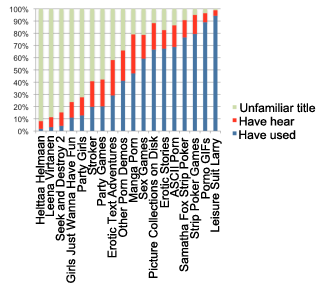
Figure shows how our informants remembered certain titles from 1980 to 1995. When we posted questionnaire we missed some notorious  games in US, such as Swedish Erotica series, that would have been really interesting to know how they have being around in Finland (our qualitative data suggest that they were not very know), but maybe we will do a followup study later.

Introduction to special issue: experiencing games: games, play and players

Petri Lankoski, Södertörn University

Annika Waern, Stockholm University

Anne Mette Thorhauge, University of Copenhagen

Harko Verhagen, Stockholm University

This is a reprint version of the introduction article for special issue in the Journal of Gaming and Virtual Worlds 3: 3, DOI: 10.1386/jgvw.3.3.175_7. The text contains DOI links to the special issue articles on Intellect site.

Continue reading “Introduction to special issue: experiencing games: games, play and players”

Perception System Explained

Here is a bit explanation how the perception system code works.

Basic features of the code is as follows

  • If the player object is behind some other object, it is not seen. This is tested with Physics.Linecast from the center of perceiving object to the center of the player object.
  • If player object is really near (distance < closeRange), the player object is noticed 360 arc.
  • If the player object is fron (angle between the forward vector of perceiving game object and the player object is less than front angle) and distance is less than frontDistance, the player object is seen.


Difficulty Graphs (by Rafael Vázquez)

Rafael Vázquez writes about evaluating the difficulty level of games on Gamasutra in the feature How Tough Is Your Game? Creating Difficulty Graphs:

They are graphical representations of how difficulty changes throughout the game. This is to say that they plot how challenge changes over time. There are two main types, time-based and distance-based. The first places the spikes in challenge according to the time spent played (taking away paused time and death); while the second places them depending on where the challenges appear (assuming a direct route from start to goal).

While the method seems to be targeted to combat-based titles (difficulty formulate uses to the number of enemies), the same idea could be extended to platformers by counting number of jumps (etc.) and multiplying that with a difficulty level?

Simple Perception System (Unity, C#)

Here is a very simple perception C# code that I used my lecture today for Unity.

Function that can be added to the Enemy class to check if the enemy sees the player object or not (the code for other functionality can be found on the post /2011/10/29/intro-to-gameplay-programming-with-unity/). With this code, an enemy can perceive player object farther away if the player object is front and when rear on the side perseption range is more limited.There is also very simple line-of-sight checking functionality.

The features of the perception system can be controlled via class variables

public float frontRange = 10.0f;
public float frontAngle = 30.0f; // if angle between forward and los is less than this, the target is at front
public float closeRange = 2.0f;

Then the function actually handling the if enemy can see the player object or not.

public bool IsPlayerWithinPerceptionRange()  {
   RaycastHit hit;
   bool playerWithinPerceptionRange = false;
   if(Physics.Linecast(transform.position, GameAgents.GetPlayer().transform.position, out hit)) {
        if(hit.transform == GameAgents.GetPlayer().transform) {
            if(hit.distance <= closeRange) {
                 playerWithinPerceptionRange = true;
                 Debug.DrawLine(transform.position, hit.transform.position, Color.black);
            }
            else if(hit.distance <= frontRange) {
                 if(Vector3.Angle(transform.forward,hit.transform.position - transform.position) <= frontAngle) {
                     playerWithinPerceptionRange = true;
                     Debug.DrawLine(transform.position, hit.transform.position, Color.black);
                 }
            }
         }

    }
    return playerWithinPerceptionRange;
}