
Staffan Björk is building version 2.0 for game design patterns (http://www.ninja.sics.se/gdp2/). Staffan is also updating and adding patterns from my Character-Driven Game Design. I am looking forward to seeing how the patterns will change after Staffan’s update.


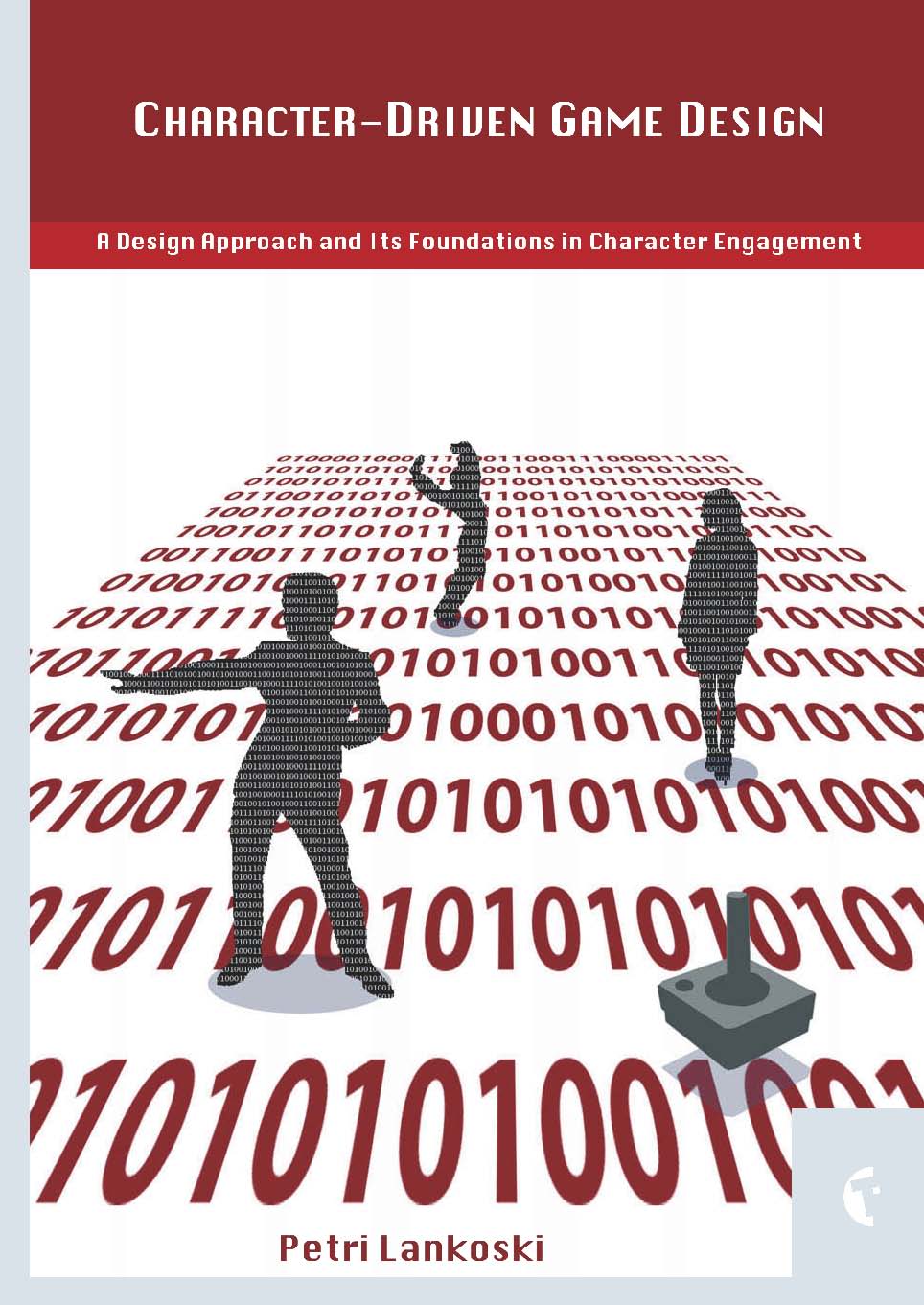
Character-Driven Game Design Available as PDF
You can download the Character-Driven Game Design now. Scroll down for the actual download link (the PDF is around 2M).
The print version is also available (35euros + handling) on the same page.
Lectio Praecursoria 12.5.2010
Introductory speech at my defense:
Honoured Custos, honoured opponent, ladies and gentlemen.
My research is about designing single player character-based computer games.
With character-based games, I mean games such as Thief II: The Metal Age, Fahrenheit, Ico, and Half-Life.
From the design point of view the player character, the character controlled by a player, is the most important character in the character-based games. Game designer Steve Mereztky claims that “the element that is most likely to leave a positive lasting impression on players are the primary character or characters“, because “humans are hard-wired to respond to other humans“. However, some researchers and game designers have been critical towards whether player characters can have personality at all, because the character is controlled by a player. It is argued that the presentation of the character is irrelevant, because it does not make one to play differently. I think that this is a simplistic view that overlooks how gameplay can guide interpretation and playing experience.
Public Examination of my Doctoral Thesis at May 12
Academic dissertation to be presented for public examination with the permission of the Research Board of the Aalto University School of Art and Design Helsinki, in Sampo auditorium (Media Centre LUME), Hämeentie 135 C
on May 12th, 2010, at 12 noon.
MA Petri Lankoski “Character-Driven Game Design: A Design Approach and Its Foundations in Character Engagement”
Opponent: Phd Ian Bogost, Georgia Institute of Technology
Custos: Professor, DA Lily Díaz, School of Art and Design Helsinki
Welcome!
Character-Driven Game Design is Out
 |
 |
| Buy the book | Free PDF |
Updated 14.5.2010: Added download link.
Back cover says:
In the Character-Driven Game Design, Petri Lankoski presents a theory that illuminates how game characters contribute to shaping the playing experience. Based on this theory he provides design tools for character-based games which utilize methods and theories derived from dramatic writing and game research.
“The use of Lajos Egri’s bone structure for a three dimensional-character and of Murray Smith’s three levels of imaginative engagement with characters allows the candidate to expose the full complexity of the imaginary persons represented and controlled in a single-player game. What makes his design-center approach even more interesting is that gameplay is an integral part of it.”
Bernard Perron, Associate Professor, Université de Montréal“Lankoski does a great job laying out the theory of primary interest to him, and making the case for the need to tether character design to game design more tightly than has been the case in the past. Certainly, too, putting attention to social networks of characters and finding useful design patterns to guide this level of game design is also of great value, and underexplored in the field.”
Katherine Isbister, Associate Professor, Polytechnic Institute of New York University
CONTENTS
CFP: Experiencing Games: Games, Play, and Players
Research on games has grown into a research area of its own. This conference aims to bring together researchers in the Nordic countries that focus on the study of games and gaming, be it on-line, computerised, or in the physical world. Based on the Nordic tradition on user-centered design, the first Nordic DIGRA conference will place a particular focus on studying design for player experience, and research on tools and methods for player-participatory design.
Continue reading “CFP: Experiencing Games: Games, Play, and Players”
Reward Systems in Univesities
Now as my university is building a reward system, I need to voice my concerns on reward systems.
First, how do you judge what is good research? One might not be able to comprehend the value of research beforehand. As an example, could anyone at George Boole’s time predict the importance of his work on mathematical logic? Moreover, if the criteria for the rewards is likely to guide the research. What if the criteria is such that it does not courage for the novel research?
Second, it seems that external rewards can have demotivating effect. Jesper Juul (in a different context) writes:
A famous 1973 experiment (“Undermining children’s intrinsic interest with extrinsic reward“) showed that when nursery school children consistently received external rewards for drawing, they lost interest in drawing and started drawing less.
Are adults different from children regarding this?
Third, other studies indicate that rewards are good in simple tasks, but the performance drastically drop when a reward is introduced if the task requires reasoning (I cannot find the references now, but some are mentioned in Dan Pink’s talk).
I hope I am wrong here, because if these concerns are valid we are misdirecting our scarce resources.
The tribulations of adventure games: integrating story into simulation through performance by Fernandez Vara
Note for myself: read this:
Fernandez Vara, C. (2009). The tribulations of adventure games: integrating story into simulation through performance. Doctoral Dissertation, Georgia Institute of Technology. URL=http://hdl.handle.net/1853/31756.
Game and Cognitive Skills
A study reports enhanced attentional resources of action game players:
This work further documents the enhanced attentional resources of action video gamers and establishes faster reaction times in that population without a notable loss in accuracy. These effects were seen throughout the age range studied suggesting similar effects of action game playing from the early school years through to adulthood. While causality can only be inferred with a training study, the findings are in accord with attentional changes that have been previously trained in NVGPs using action video games.1
Study also site several other studies showing similar results.
Notes
- Dye, Green & Bavelier (2009). The development of attention skills in action video game players. Neuropsychologia 47(8-9), pp. 1780-1789, http://dx.doi.org/10.1016/j.neuropsychologia.2009.02.002.
Player Character Engagement in Computer Games
My paper Player Character Engagement in Computer Games was accepted to Games and Culture. Here is the abstract:
This article argues how players can control a player character influence interpretation and facilitate engagement within a game. Engagement with player characters can be goal-related or empathic, where goal-related engagement depends on affects elicited by goal-status evaluations whereas characters facilitate empathic engagement. The concepts of recognition, alignment, and allegiance are used to describe how engagement is structured in games. Recognition describes aspects of character interpretation. Alignment describes what kind of access players have to a character’s actions, knowledge, and affects. Allegiance describes how characters elicit sympathy or antipathy through positive or negative evaluation of the character.
 Petri Lankoski